How much of your TAM do you need to capture to build an IPO-scale, vertical SaaS business?
TAM is one of the most important questions for every GTM team. The questions typically focus on the size of the overall TAM. They rarely focus on answering the question “How much of your TAM do you need to capture?”
ServiceTitan is an ideal candidate for answering this question because they're one of the few pure-play vertical SaaS businesses (the trades) who have gone public.
This means we can review their publicly reported customer numbers and financials. All of that makes them a great benchmark for similar vertical SaaS businesses that are looking to replicate its success.
It's also a business where you can detect a good portion of their customers who are using them, via public booking links or code living on customer websites, which lets us examine the characteristics of their customers by enriching these accounts with location count and other signals.
A primer on Service Titan
Primer for those unfamiliar with ServiceTitan:
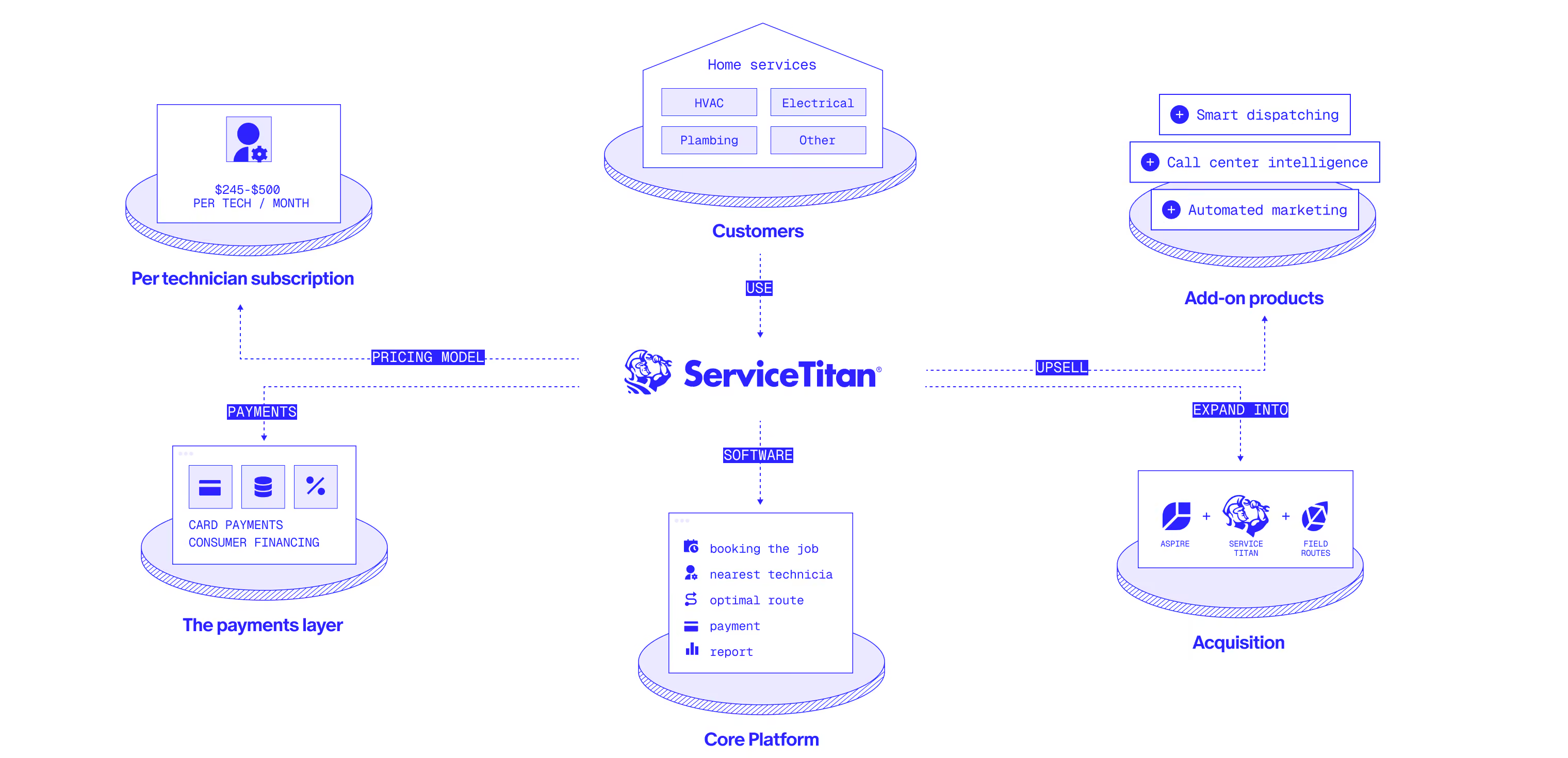
ServiceTitan makes the software that runs home-service businesses: the companies that send technicians to your house to fix your AC, unclog your drain, or rewire your panel.
When a customer calls, ServiceTitan helps book the job, dispatch the nearest technician, route their truck, build a quote on a tablet, take the payment, and report back to the owner how much money the business made that day. Before tools like this, many trades businesses ran on whiteboards, paper invoices, and QuickBooks. Many still do.
The core mode
Paid per technician. ServiceTitan charges a monthly subscription for every field technician a business puts on the platform, charging roughly $245 to $500 per tech per month depending on the package. This means their revenue scales with the size of the customer's workforce: a 20-truck shop pays roughly 20 times what a one-truck shop would.
The ecosystem
The core subscription is just the entry point. On top of it sits a menu of "Pro" add-on products. These include automated marketing, call center intelligence, smart dispatching, and more, with each sold separately.
They've also acquired their way into adjacent trades (Aspire for commercial landscaping, FieldRoutes for pest control). The result is that existing customers reliably spend more every year, which is why well over half their growth comes from expansion rather than new logos.
The payments layer
A cut of every invoice. For every quote and invoice that flows through ServiceTitan, they process the customer's card payments and offer consumer financing for big-ticket jobs, taking a slice of each transaction.
What percentage of the overall trades market does ServiceTitan capture?
According to ServiceTitan's public facing financial reports, we can see that they have ~10,800 customers. For the sake of this analysis, we'll reference these customers as "accounts", which are companies that may have multiple *locations, and that all their customers are US-based (not true, but impossible to disambiguate).
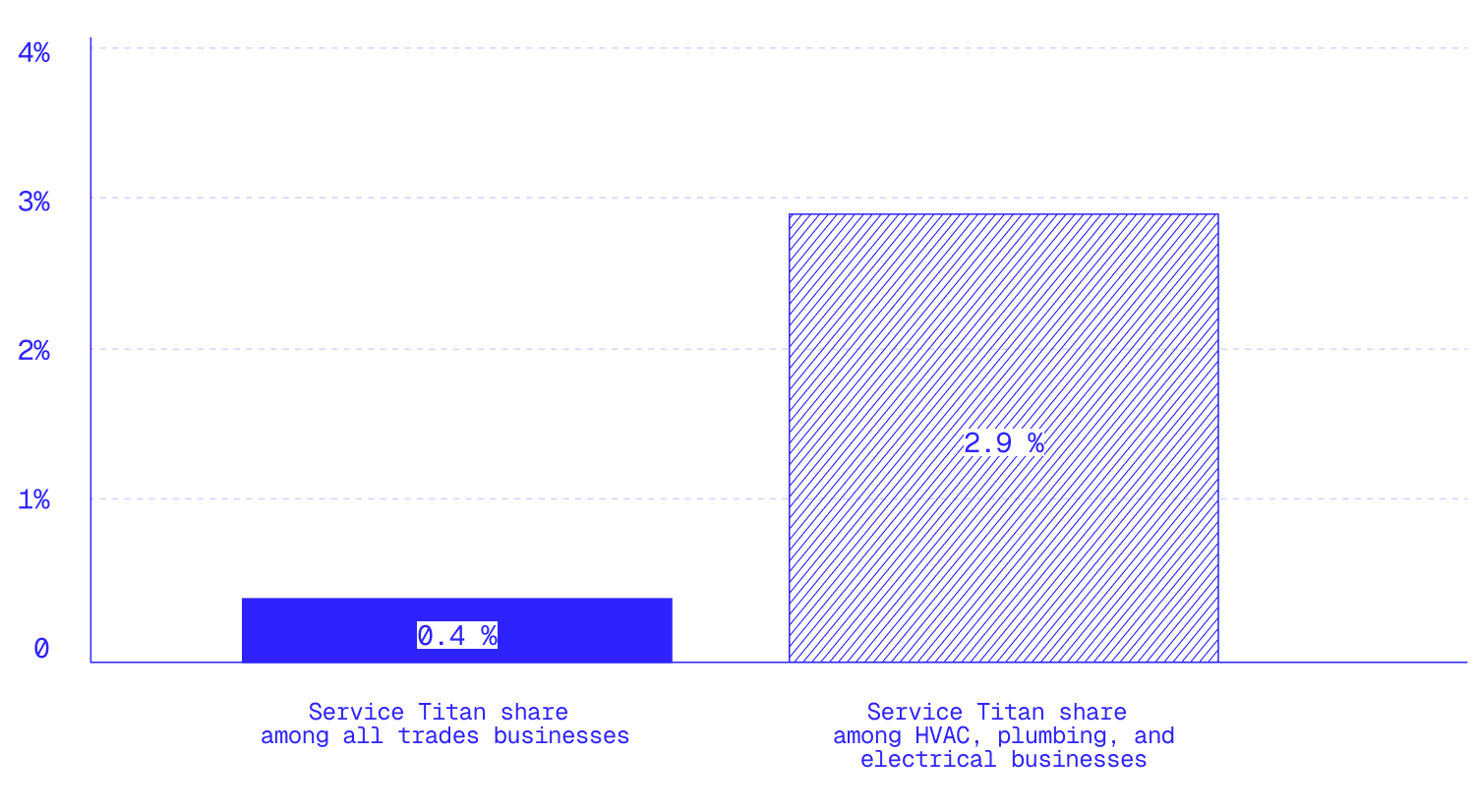
When we look at DataLane's count of trades businesses (plumbing, hvac, electrical, landscaping, pest control, etc), we count ~2.7 million active, operational businesses. That implies ServiceTitan captures around 0.4% of the overall trades market in the US.
But ServiceTitan doesn't necessarily serve every account within the overall trades market. Their strongest markets are HVAC, plumbing, and electrical, which find value from FSM software that supports the lifecycle of scheduling, dispatching, quoting, invoicing, and more.
We found 376,000 businesses in the US that fit that description. At most, ServiceTitan has captured 2.9% of the overall market.
That 2.9% hides a lot of nuance. Even when you focus on a subvertical like “HVAC”, you miss that there are a wide variation of HVAC businesses. Some of these are mom and pop operators with 1-2 technicians. Others are PE backed businesses with hundreds of techs and sophisticated systems.
So let’s take a more nuanced, actionable view of ServiceTitan’s TAM.
Comparison diagram
Understanding ServiceTitan’s segmentation and focus
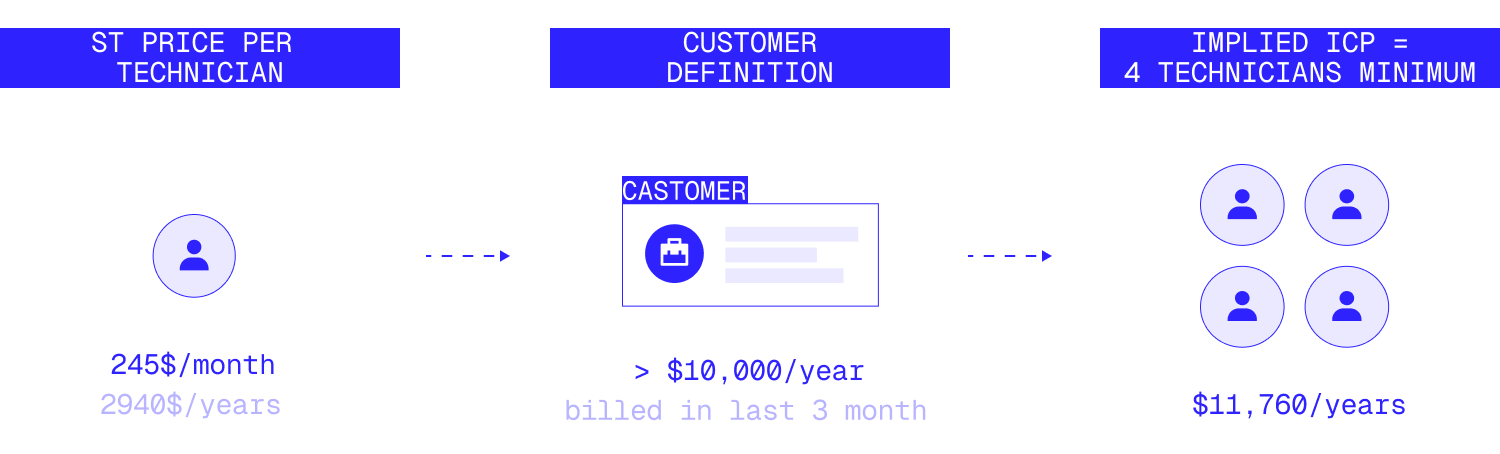
ServiceTitan does a lot of the work for us by clearly defining their customer. Their annual report highlights that a “Customer” is defined as an account with over $10,000 in annualized billings who were billed in the last 3 months.
Their cheapest plan sits at $245 per tech, per month. To hit their $10,000 annualized billing threshold, this implies that ServiceTitan is largely targeting businesses that have a minimum of 4 technicians.
Ideally, I would be able to see ServiceTitan’s share of businesses with 4+ techs. But getting technician count correct can be tricky. So I opt to pick a different and more reliable signal of scale - location count.
When you break out electrical, plumbing, and HVAC businesses (EPH) by location count in our dataset, we can see that ServiceTitan is detected on 3.9% of those businesses with 2 locations, and over 10% for businesses that have 3+ locations, 17% of businesses with 5-9 locations, and 16% of businesses with 10+ locations.
A great example of ServiceTitan’s ideal customer would be Roto-Rooter. They have over 600 locations in the US and Canada. Roto-Rooter and ServiceTitan announced a partnership as of September 2025. Roto-Rooter is a publicly traded subsidiary of Chemed (NYSE:CHE).
They also have announced a partnership with Authority Brands and Neighborly. The former covers hundreds of franchisees across brands such as Mister Sparky, One Heating & AC, and Benjamin Franklin Plumbing. With ~2700 locations operating.
The latter covers brands such as Aire Serv, Mr. Rooter, and Mr. Electric, with ~5500 operational locations.
So ServiceTitan has a very clearly defined ICP within the overall market that they're going after. They want to dominate and own the midmarket and enterprise side of the market, to the point that they won’t even call a 1-2 technician business a “customer”.
This stands in stark contrast to other players in the FSM space like Housecall Pro who claim to work with 45,000+ customers. But as you move upmarket you see that their share of the market declines relative to ServiceTitan
EPH multi-loc accounts with detected FSM
Benchmarking for other vertical SaaS founders
So after 19 years in business and an IPO, ServiceTitan has executed on a specific segment, capturing around 10%+ of the mid-market and enterprise segments.
The incorrect takeaway from this analysis is that every vertical SaaS company needs to move upmarket and sign enterprise deals. Those deals with Authority Brands and Neighborly happened in 2024 and 2025, more than 17 years after the company was originally founded. Many things have to go right for a company to earn the right to win those enterprise deals.
A better takeaway from this investigation is that every vertical SaaS looking to reach IPO scale needs to walk through an intellectually honest TAM sizing exercise.
Part of that exercise is identifying sub-segments they have a right to win through current or future product developments. ServiceTitan shows us that:
- You don’t need to win the entire market to build a massive business.
- For the segments that you do want to win, push for 10%+ market share in that segment against competitors. Build a credible path to winning that market share
- Discipline - orient the entire company around a clear definition of “Customer”, and everything your product and GTM teams action should be aligned towards landing more of those accounts.
Explore more