Resy and OpenTable are fighting for stars, who has more Michelin Guide Restaurants in NYC?
“Where are you going for dinner?”
This is the most important question on Friday in the office, repeated across millions of New Yorkers. On our Bizops team, Christian has made it his mission this year to review 150 restaurants. You can follow him on Beli (@christiansoriano).
He actively questions the taste of our Enterprise AE Max who once reviewed Blank Street Coffee at 9.4 (?) on Beli, while simultaneously stating that Christian’s favorite restaurant Eyval was only an 8.4. Their relationship has not recovered.

You better have a reservation…
NYC is a battleground of taste. And one of the ultimate arbiters of taste is the Michelin Guide. In a city with ~20,000 restaurants, only 356 (1.2%) make it onto the Michelin Guide.
NYC is a city of lines. And snagging a reservation at any of these Michelin Guide restaurants is a feat worthy of praise. Top restaurants are often booked out weeks in advance.
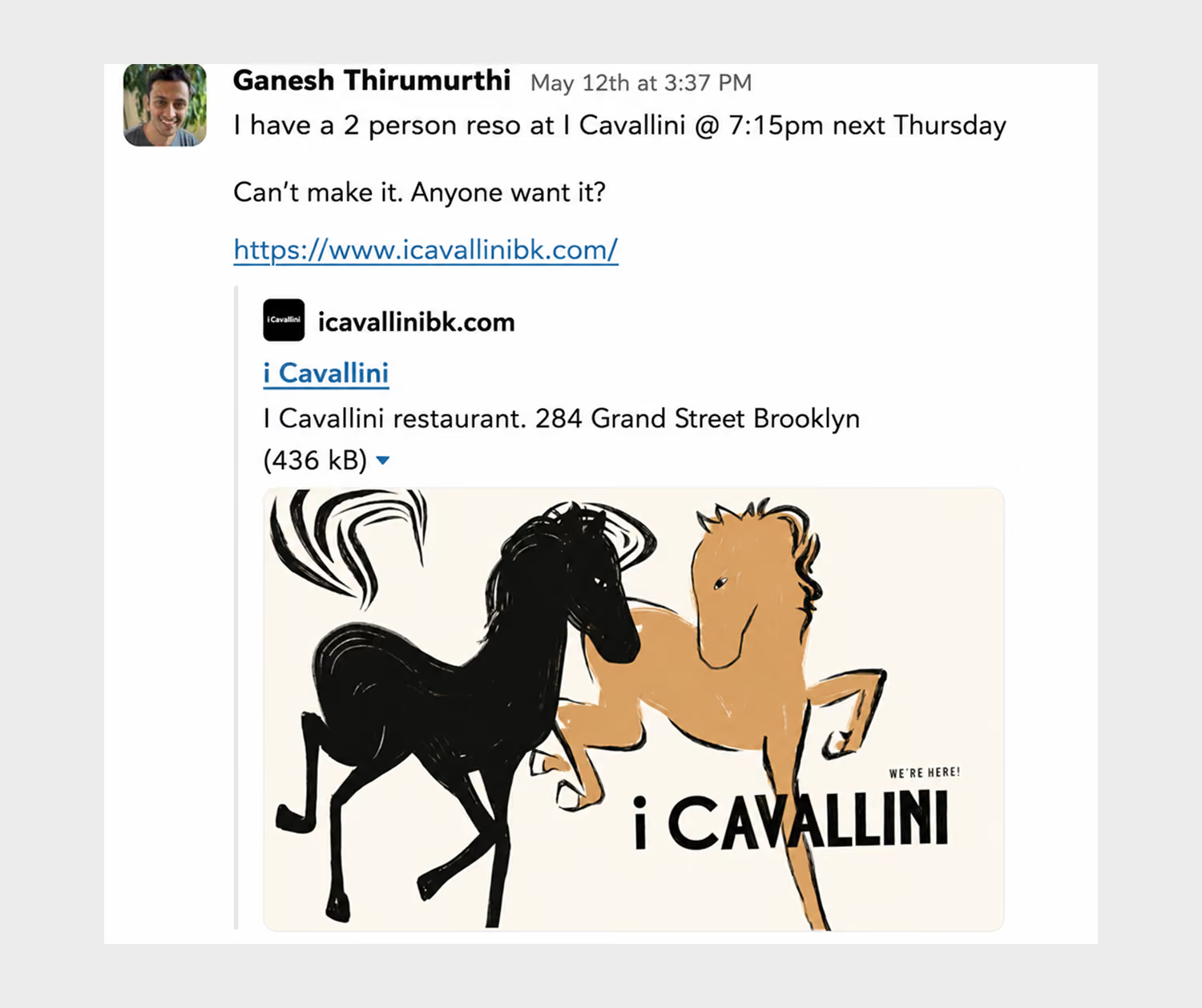
This lesson hit home when I first tried to get a spot at Jeju, a 1-star Michelin, it was booked out for a month in advance on Resy. My partner was not pleased!
But the restaurant business is tough. You can get onto the Michelin Guide. You can sellout. It might not matter. One study showed that getting listed on the Guide actually correlated with an increased likelihood of closure.
So credit card companies spied an opportunity and swooped in. Amex and Visa want to lock in the wealthiest spenders and make their fees off their spending (they receive a % of every dollar spent). The wealthiest spenders want to skip the line and dine at the hottest restaurants in town. Restaurants wanted more cash.
It’s a match made in heaven.
Do you have an Amex or a Visa?
So Amex bought Resy. They rolled out Global Dining Access, which allows their top spenders to secure exclusive dinner reservations.
They also recently bought Tock, from Squarespace for $400 million. Tock is another reservation platform with a focus on fine-dining and prepaid ticketed reservations.
There are now rumors of 7-figure exclusivity deals being signed to lock in restaurants onto the platform. I can now get my reservation at Jeju…if I just had the Amex Platinum’s Global Dining Access.

To match Amex, Visa partnered with OpenTable to launch the Visa Dining Collection. That new partnership armed OpenTable with cash to execute their strategy. They are now aggressively using that cash to sign new restaurants. This Visa partnership ended in July of this year, and OpenTable continues to partner with Chase Sapphire on their Exclusive Tables program.
.avif)
.avif)
In a piece by the NYT, restaurateurs have confirmed cash payments being offered by OpenTable to switch off Resy ranging from $40,000 to $95,000.
But is it working? Is OpenTable signing hot restaurants? We looked to DataLane’s data to find out.
Methodology
We focus on NYC only, the city in the US with the highest count of Michelin Guide restaurants.
Within our DataLane dataset, we have every restaurant in NYC (and the US), labelled with their name, zip code, website, and tech stack.
One tech stack that we track is reservation vendor, and we can detect whether a restaurant is booking reservations on Resy, OpenTable, Tock (also owned by Amex) or somewhere else.
We don’t have any data on the Michelin Guide restaurants, so we used a Kaggle open data set of all Michelin restaurants, and then matched it against our data. We join the datasets together using a match on domain, along with checks on location and restaurant name.
We initially pulled this dataset in June 2026, so it may get stale. The marketplace is dynamic!
There are 69 restaurants with a Michelin Star in NYC. 46 of them are exclusive to Resy or Tock
71% of restaurants with a Michelin star use either Resy or Tock.
I was actually a bit surprised to see the prevalence of Tock on this list, which has a slightly higher count (16) of Michelin starred restaurants vs OpenTable (10).
Why is Tock so successful? It turns out their specific business model was uniquely suited for high-end restaurants as they pioneered concepts like prepaid deposits, which gave a lot more predictability and security for low seat count, high demand restaurants.
Jungsik is a good example of this model, where a reservation requires a prepaid deposit of $335 per person to book a slot in their Main Dining Room.
You can use Resy or Tock to book 226 of 356 Michelin Guide restaurants
63% of the guide · 51 of 69 Stars
American Express owns both. Put Resy + Tock together and NYC's prestige tier tilts decisively to Amex.
Reservation software market split across 356 Michelin Guide restaurants
.avif)
What reservation platforms are NYC's Michelin starred restaurants using?

Tock’s surprising prevalence shows that they managed to sign restaurants within a specific niche where they had a clear "Right to Win”. That supply of restaurants was attractive enough to Amex, that they were willing to pay $400 million to acquire these exclusive restaurants for their customer base.
What’s interesting is that Tock features like prepaid reservations and tasting menus have already been copied. Resy and OpenTable give restaurateurs the ability to do the exact same things as Tock, but these restaurants have still not switched over. Get to your strong fit customers first and they will stay with you.
It does appear that Amex is trying to consolidate the two platforms moving forward. When I try to sign up to Tock as a business, it now sends me to Resy.
.avif)
OpenTable is poaching Michelin Star restaurants from Resy
While the overall count (10) for OpenTable exclusives are lower, it’s clear that they are starting to find success poaching restaurants off Resy and turning them into exclusives.
OpenTable books 99 of 356 Michelin Guide restaurants in NYC
28% of the guide · 14 of 69 Stars
And they are successfully signing exclusives with marquee Michelin Stars like Gramercy Tavern, Estela, and Bar Miller. They have 10 exclusive Michelin-starred restaurants on their platform
Our analysis flagged Gramercy Tavern, a 1 star Michelin restaurant as currently being an OpenTable exclusive.
We know that in 2019, Gramercy Tavern had joined Resy, and as recently as 2024 were still on the platform, with a Resy article doing a profile on the restaurant.

Gramercy Tavern is not the only Michelin Star that has pivoted to being an OpenTable exclusive.
We have a full list of those exclusive OpenTable restaurants below. They include well known spots such as Casa Mono (1 star), Estela (1 star), and Bar Miller (1 star).
This list of reservation platform exclusives give credence to two ideas:
A) There are significant incentive fees and a concerted effort from OpenTable and Visa to onboard restaurants onto OpenTable and switch off Resy.
B) OpenTable’s product is improving rapidly, and is winning over some of these restaurants from Resy and Amex.
Unverified comments from users on Reddit highlight both themes as being top of mind for restaurant owners, with concerns about Resy being unfriendly for operators while OpenTable feels better for backend operations.
.avif)

This also lines up with some of the strategic priorities we see being pushed from Debby Soo, who joined OpenTable in August 2020. She calls out a few priorities that reflect what we’re also seeing in the data in an Apr 17th interview with Bloomberg.
Soo is laser focused and aware of the need to win back the best restaurants, she is also hyper-aware of the need to improve the product to drive value to offset OpenTable’s cost:
Michelin Star restaurants becoming OpenTable exclusives are not happening by accident. There is clearly exec awareness on the importance on winning the “best” restaurants, and we’re seeing that fight play out in real-time across our data.

The reservation wars in NYC are heating up. SevenRooms & DoorDash are also fighting for Michelin Guide restaurants.
What really surprised me was seeing that 33 restaurants on the Michelin Guide in NYC used SevenRooms. Of those 33 restaurants, Sevenrooms has eight exclusive restaurants where no other reservation vendor was detected. Three of those exclusive restaurants are Michelin Star restaurants. They are Rezdôra, Sushi Noz, and Noz17.
DoorDash's SevenRooms books 33 of NYC’s Michelin Guide
9% of NYC's Michelin guide · 7 Stars
They are particularly strong in signingmulti-location accounts and hospitality groups.
What’s going on here?
SevenRooms positions itself as a “CRM, marketing and operations platform for growing restaurants in the hospitality industry”.
DoorDash purchased the company in 2025. But isn’t DoorDash at its core a delivery vendor? Why would they try to purchase reservation software for the hospitality industry?
In DoorDash’s annual report, they split out their business into Marketplaces (what you know to be DoorDash) and Commerce Platform. The latter they highlight as a merchant SaaS suite that supports “white-label delivery, online ordering, branded mobile apps, manage reservations, in-store dining, and consumer relationships”.
What’s going on here? Likely culprits on why we’re seeing DoorDash diversify away from Marketplaces:
- Delivery is maturing and low margin, the growth rate for their order volume has been slowing
- Delivery is the smallest portion of spend at restaurants, DoorDash wants to own a larger share of the payment flows.
Financial and Operational Highlights - DoorDash's 2024 Annual Report
They want to build a consumer data graph that lets them drive clear outcomes for restaurants with DoorDash Ads. One clear outcome restaurants value (and would be willing to pay for)? A booked reservation. But without a reservation platform integrated, it’s really hard to prove you are driving those outcomes.
Keep in mind, ads are a much higher margin business. Their exec team calls it out as a core driver of increased margins in their 2024 annual report where net margin “increased to 13.4% in 2024 from 12.9% in 2023, primarily due to an increased contribution from advertising revenue.”
Buying strategic customer relationships to kickstart their flywheel
With SevenRooms, they are buying a user base of some of the highest spenders on SevenRooms - which are attractive to advertisers.
They are also buying relationships with strategic accounts. SevenRooms specializes in multi-location hospitality groups. When we look at our data, we see that close to 42.4% of their customers are multi-location.
You don’t want to let someone else lock in the reservations layer
The only other choice for DoorDash was to build its own reservation platform from scratch or let someone else buy one of the few remaining independent. The reservations layer is the gateway to high-spend consumers, platform lock-in, and measurable lock in. You don’t want to let another player (Uber?) steal that away from you, and then force you to build from scratch.
SevenRooms was founded in 2011 and acquired in 2025. It took them 14 years to get 1790 restaurants onto the platform. It would have certainly taken DoorDash years to build parity in marketplace supply (restaurants + users), with no guarantee of their ability to sign up strategic accounts. You know who else could have bought SevenRooms? Toast. They have their competing Toast Tables product (launched 2023) and a restaurant advertising product.
Our dataset detects Toast Tables on only one Michelin Guide restaurant in NYC. That would be Thai restaurant Untable, a Bib Gourmand based in Brooklyn.
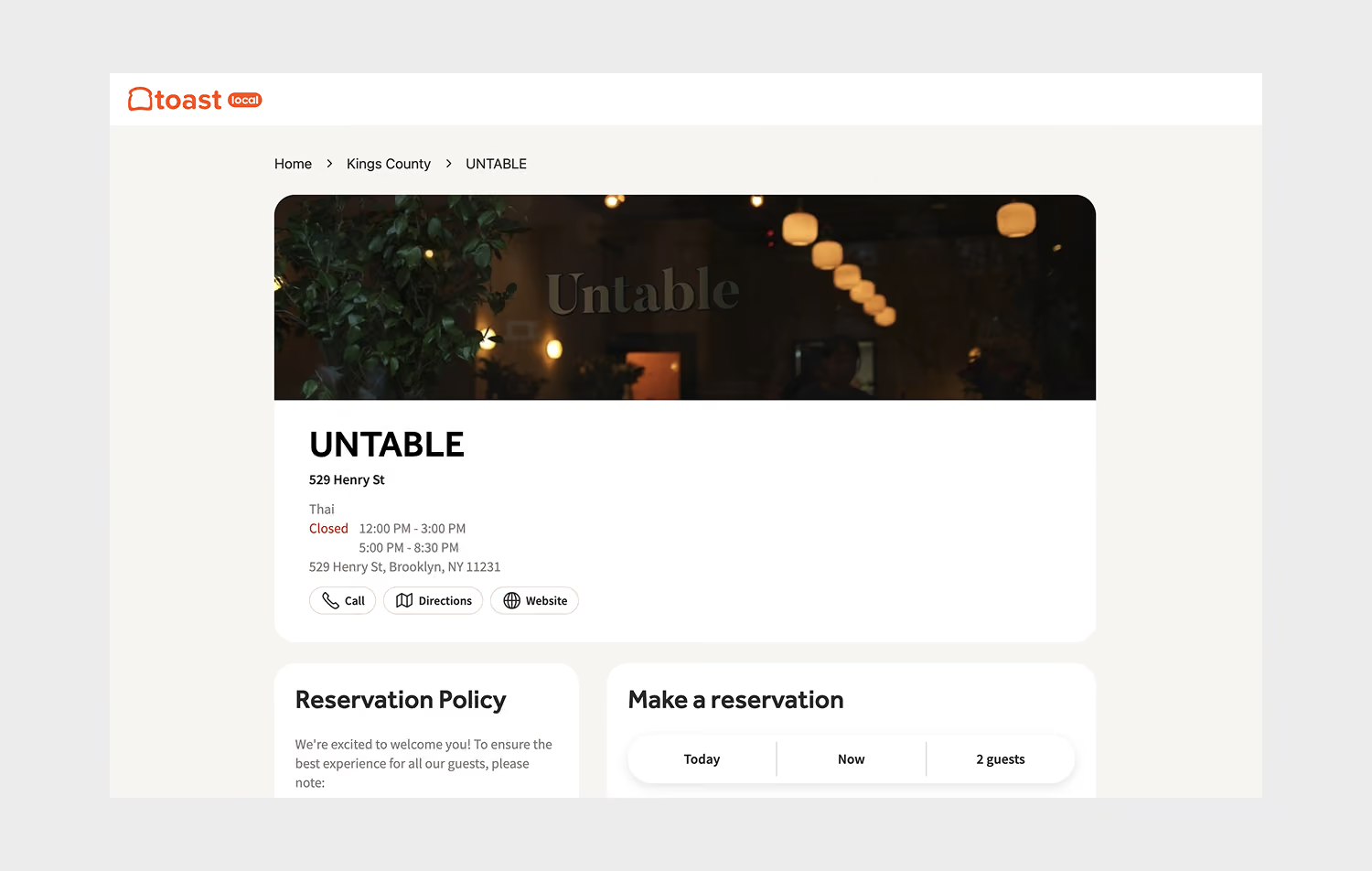
Own the reservation layer, own the customer relationships. Lock out competitors, make them work harder to rip and replace your installed product. It makes a bit more sense now!
This is no longer just an OpenTable vs Resy race. SevenRooms and DoorDash are gearing up for a fight. Part of that fight is talent. They recently poached Alexandra Widrick, who was Chief of Staff, then Director of Strategic Partnerships at Resy+Tock. She is now leading Strategic Partnerships at SevenRooms.
Head to head · NYC Michelin
Resy + Tock
Booking
DoorDash
NYC is its own market, outside of major cities, OpenTable takes ~50% market share of reservations
One important thing to note - NYC is its own isolated market with unique dynamics. Resy may be leading in NYC - but we should also just gut check and see what the national dynamics look like.
What we found? In the rest of the US, OpenTable is the default. We detected 27,332 locations with OpenTable relative to 9,540 for Resy. We detect OpenTable on 49.8% of locations that take reservations.
It’s not just in small markets or towns either. OpenTable leads Resy in markets like Miami, Dallas, Boston, Austin, Los Angeles, San Francisco, Houston, Atlanta, and Dallas.
These are some of the fastest growing cities in America. Miami saw a 10% population growth since 2020 vs. a 3% decline for NYC.
OpenTable still dominates nationally
(Platforms, hover to to isolate, click to pin)
It will be decades before a city beats the sheer volume and density of NYC in terms of wealthy spenders. But if more of the millionaires and wealthy spenders are moving to (or being minted in) cities like Miami, Austin, and SF, the appeal of the Amex card greatly diminishes for spenders in those markets.
You don’t want to give those consumers a reason to consider a Visa card (Chase Sapphire Reserve?) instead. How does Amex respond? The reservation wars are heating up, we’ll check back in a year to see how this changes.
Explore more